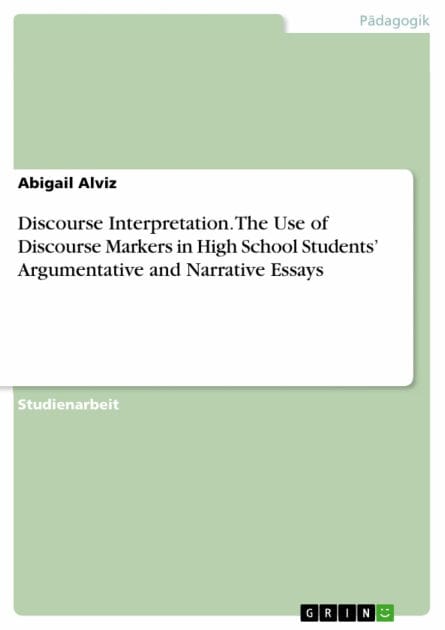
Discourse Interpretation. The Use of Discourse Markers in High School Students' Argumentative and Narrative Essays
by Abigail Alviz
✓ In Stock
💰 Cash on Delivery available
Book Details
- ISBN
- 9783668018532
- Publisher
- GRIN Verlag GmbH
- Published Year
- 2025
- Pages
- 25
- Language
- German
- Category
- Foreign Languages
Description
Studienarbeit aus dem Jahr 2015 im Fachbereich Didaktik für das Fach Englisch - Pädagogik, Sprachwissenschaft, , Sprache: Deutsch, Abstract: Writing, as a macro skill, has been a central focus in most Philippine curricula in the last three decades and continues to be so. Filipino students are taught varied strategies on how they can improve their writing to produce well-organized texts. Specific writing devices are needed to help students formulate cohesive and coherent texts. Several studies have aimed at analyzing these devices, generally termed as discourse markers (DMs), which were considered as 'growth market in linguistics' by Fraser (1998). DMs were first dealt in a seminal paper by Halliday and Hassan (1976) when they analyzed text and questioned: 'What makes a text different from a random collection of unrelated sentences?' Although the direct use of the term DMs was not mentioned, Halliday and Hasan, proposed a set of cohesive devices (reference, repetition, substitution, ellipsis, and conjunction) that 'help create a text by indicating semantic relations in an underlying structure of ideas.' Fraser (2009) found that several expressions are used to refer to DMs including cue phrases, discourse connectives, discourse markers, discourse operators, discourse particles, pragmatic expressions, and pragmatic markers. DMs are linguistic items such as well, however, so, because, etc. which contribute to the cohesiveness, cohesion, and meaning in discourse segments. Fraser (1990) provided an account of DMs to clarify their status and defined DMs as 'a class of lexical expressions drawn primarily from the syntactic classes of conjunctions, adverbs, and prepositional phrases.' In analyzing DMs, two accounts have emerged to which researchers subscribe. The issue highlighted in this difference is regarded to 'how the use of DMs contributes to discourse interepretation' The current study seeks to identify, quantify, and analyze the use of DMs in high school students' argumentative and narrative essays. It also intends to probe into the relationship of the frequency and use of DMs to the quality of the students' writing, Specifically, it would answer the following: 1.What types of discourse markers are utilized by Grade 9 Filipino ESL learners in personal narrative and argumentative writing? 2.Are there any significant quantitative and qualitative differences in the use of discourse markers by Grade 9 Filipino ESL learners? 3.Is there a direct relationship between the number of discourse markers used and the quality of students' writings?